

In the marketing world, we often see clients jump to tactics – the fun stuff – before the real, deep-dive strategy work is done.
And I get it. Tactics are exciting and finding solutions is satisfying. But to build a marketing campaign that nails it, you need to look at the whole board first to make the best strategic decisions. That means deep audience research, nailing your positioning, and setting smart goals before you decide on the tactical execution.
By taking a breath and putting in the hard strategic yards early, you will make significantly better tactical decisions and be pleasantly surprised by your campaign results.
1. Understand the problem before jumping to a solution
When you’ve been experiencing an issue for a while, it’s easy (especially if you’re in a rush) to jump into tactics to solve the problem before you’ve done the hard work of diagnosing it. Before finding a solution, it is vital to understand and diagnose the specific problem at hand, otherwise you might pick the wrong solution and waste your time and your budget.
But how do you do this hard diagnostic work? We’d recommend pulling your team together, looking at the problem at hand and asking some deep, probing questions about your target audience, your business landscape, and your campaign process. Consider engaging Cadence to help you and your team problem solve and come up with creative solutions to the barriers you’re facing. There are solutions to the issues you’re having and often we need to pause before jumping in a new email campaign or digital ad strategy.
2. Always start with your audience
If you don’t know who you are targeting, your tactics won’t work and your campaign will struggle. We see this all the time. Marketers just don’t know enough about their audience to make strategic decisions about them.

Here are some things to think about:
- Who out of your potential audience are you targeting?
- What is known about them? What can you find out?
- Why would they be interested in your cause?
- Bonus question: Does your current audience align with who you think your audience is?
By taking a breath and putting in the hard strategic yards early, you will make significantly better tactical decisions and be pleasantly surprised by your campaign results.
3. Let data be your “source of truth”
A strategy without data is just a guess, so a data-informed strategy is non-negotiable. Data provides the factual foundation for any strategy built around an audience. Key sources for this treasure trove of facts include:
- Donor information and segments.
- Qualitative and quantitative research.
- Past campaign reviews and CRM or Meta reports.
4. Set simple and disciplined goals
The best goals are the simplest ones, though they often require making hard choices between what you will aim for and what you’ll leave on the table for now. Effective goals should be:
- Specific and clear: Make your goals unambiguous, such as increasing newsletter signups by 20.
- Measurable and time bound: Your goal should be tied to metrics eg. clicks, conversions and set against a firm deadline.
- Aligned and actionable: Goals must support the broader mission and directly inform your content and messaging.
5. Establish a realistic budget early
Knowing the budget early is critical for strategy because it allows you to identify the best options for that specific amount. It is important to distinguish between the budget for agency work and the budget for actual campaign execution. While budgets are often tight, a realistic ad spend is necessary for a campaign to succeed.
6. Commit to the Wrap Meeting
We get it. The last thing you want to do after a campaign is go over it with a fine toothed comb. But trust us when we say that we’ve found it to be one of the most rewarding steps for our clients. They’ve reflected on their decisions, felt proud of what they’ve achieved, and got excited about what’s possible for the next campaign.
Wrap meetings allow teams to:
- Learn and justify: Use data to justify decisions for the next campaign.
- Analyse mistakes: Mistakes are always going to happen. Calling them out and learning from them is essential for growth and understanding.
- Focus on growth: The goal is to be encouraged by what we’ve achieved but also to take the key lessons through to the next project.
If you need help implementing some of these techniques into your campaign marketing, we’d love to help you out.
Have you ever felt like your campaign had a wobbly start and a rudderless end?
It’s a common feeling. Maybe no one is quite sure of the budget, but everyone is eager to start getting their hands dirty. Timelines are tight, but the brief is a bit of a blur. You find yourself facing questions you don’t have the answers to, and suddenly, the whole campaign feels like you’re throwing darts at a board you can’t actually see.
At Cadence, our biggest learning this year has been a simple one: trust the process, specifically, the Strategic Marketing Process
Whether you’re running a seasonal appeal, an awareness campaign, or a re-engagement drive, we’ve found that committing to a structured loop is the secret to making campaigns the best they can possibly be.
The Model – and why it’s not just fluff
Our process isn’t something we just pulled out of thin air. It’s adapted from a model created by seasoned marketing strategist, Mark Ritson for commercial marketing. We’ve tweaked it for the fundraising space because, quite frankly, it works. It’s a tried-and-tested loop that helps you build momentum rather than starting from scratch every single quarter.
We break it down into four main stages: goal setting, strategy, execution, and analysis.
If you imagine a campaign running over four months, you’d spend the first month on goals and strategy, two months on execution, and the final month on analysis. Crucially, that analysis feeds directly back into the goals for your next cycle. It’s a positive feedback loop.
1. Setting goals – beyond just raising money
We all know the ultimate goal: hit the donation target. But to get there, we need to look at the smaller, specific goals that act as stepping stones.
Maybe you want to grow your donor base by 3% or build a new audience on Instagram. We like to sit down with our clients, look at their unique situation, and suggest goals that actually make sense for their budget. Before we even think about the creative, we need to know what we’re aiming for.
A good goal should be:
- Specific and clear
- Measurable
- Time-bound
- Mission-aligned
- Actionable & reviewable
2. The Power of Diagnosis and Research
It’s tempting to skip straight to the cool stuff (e.g. the tactics and the creative) especially when you’re rushed. But we prioritise diagnosing the problem before jumping to a solution.
Research means taking a step back to look at the landscape: your resources, the audience, and the specific gaps your brand can fill. This is why we often suggest engaging with us earlier than you think you need to. Even if a campaign is six months away, starting the diagnosis early is all gain and no loss.
3. Strategy: Your True North
Once the goals are nailed and the research is done, we write the plan. A strong strategy at Cadence always ticks these boxes:
- Audience-focused: the plan is all about targeting the right people.
- Message-led: we get crystal clear on what you want them to know.
- Channel-aware: we define exactly where we’re showing up.
- Flexible: we love structure, but we aren’t rigid. The strategy needs to be agile enough to pivot.
4. Creative and Execution
This is where the strategy comes to life. If we’re handling your creative, we’re designing the visuals (or as we like to call it “look & feel”), crafting the messaging, and rolling it out – based strictly on the strategy we’ve already built.
Sometimes clients want to do the creative first, but we really encourage doing the deep work of planning early. It actually ends up costing you less in the long run because the creative team knows exactly what they’re aiming for from day one and they often hit the bullseye earlier.
When it comes to the actual “doing” (the ads, the emails, the mailouts), we stay:
- Resource aware: We won’t recommend something your team hasn’t got the capacity to handle.
- Collaborative: We love weekly WIPs to keep aligned on what’s happening and work alongside you as the campaign roles out.
- Data-informed: We’re always watching the numbers and pivoting tactics as we go.
5. The Post-Mortem (the bit everyone skips)
Let’s be honest: once a campaign is over, everyone wants to look at the final total and then take a holiday. Getting everyone back in a room to look at the numbers is often a tough ask. But in our view, the analysis is the most crucial part of the loop because it sets up the discovery for your next campaign.
This is where you learn about your audience’s quirks, your team’s hidden strengths, and which tactics actually moved the needle. Plus, having these “proof points” and hard numbers is the best way to secure a positive budget for next year. Often our clients come away from these meetings feeling refreshed, excited about the next challenge, and very thankful they didn’t skip it.

So, what does this all mean for you?
- Book in early: Come to us at least three months before you want to go live. That gives us time to do your campaign really well.
- Bring your data: Show us the full board – your audience, your past campaigns. We want to see everything; the good, the bad, and the ugly.
- Collaborate: Come alongside us as we build the strategy together.
If you need help implementing some of these techniques into your campaign marketing, we’d love to help you out.
We’ve got something uncomfortable to share with you.
“One third of all marketing budgets are potentially wasted due to poor briefs.”
That’s not all…
“80% of marketers think they’re writing good briefs. Only 10% of creative agencies agree.”
These insights came from a group called Better Briefs. They’re a company that wants to help agencies and their clients work together in a more cost effective way (which we all love). Every year they do a bit of research around how well the briefing process is going in creative agency land and…we reckon there’s room for improvement.
“60% of marketers use [their agency’s] creative process to clarify their strategies rather than being clear about these from the outset.”
“60% of marketers use [their agency’s] creative process to clarify their strategies rather than being clear about these from the outset.”
That’s one pricey way to write a brief.
These learnings aren’t new to us at Cadence. The briefing process is rarely linear. Emails back and forth. Meetings to “align” and “circle back”. This is a very messy and costly process – and happens more often than you think.
Most of the time we’re ok with this process. We’re passionate about collaboration. We like to meet clients where they are at, and help them along the journey. But we do sometimes wonder if organisations realise just how much money they could be saving if they were to refine their briefing process.
Cadence is passionate about working for brands that want to do good in the world. That means we’re often working with tight budgets made up of precious donated funds. We want to help you use those budgets well so we thought it might be helpful to write this resource to help you write a good brief and save some of your marketing budget for the stuff you wish you could do.

It’s really hard to write a good brief
A caveat before we begin. Most people don’t know how to write a brief because it’s really hard. It requires know-how and help. For most of us, it’s a special skill that’s learnt and honed over time. It also requires your executives and teams getting you information you might not have and in a timely manner. So cut yourself some slack and see it as something we’re here to help you get better and better at.
Without further ado, here are the key elements of a great brief.
1. Executive summary
Start with a high-level overview. What’s the main goal of the project? This should be a concise paragraph that gives Cadence a quick understanding of the project’s purpose and what success looks like.
2. Who are you & what do you do?
Provide a brief introduction to your company. What do you do? Who are you? Also, describe the specific product or service this project is about. What does it do, what makes it unique, and how does it fit into your larger brand?
If you’ve worked with us before, you might want to include any information we don’t know that would help us with the problem you need our help with.
3. Background & situation analysis
Why is this project happening now? What’s the context? Include any information you might have about the market landscape, key competitors, and any previous campaigns. This helps Cadence understand the environment they are creating for and what you are up against.
If you don’t have this, that’s fine, but if you do, don’t hold back.
4. Business & marketing objectives
What are you trying to achieve? Be specific, time bound, and use metrics. For example, instead of “increase donation,” say “increase donations by 15% for our May June appeal” or “drive 1,000 new email sign-ups in the next three months.” This gives Cadence a clear target to aim for.
If you’ve only got general goals, that’s ok, we can help you with the clearer metrics.
5. Target audience
Who are you talking to? This needs to go beyond basic demographics. Create an audience profile or a persona. What are their behaviours, motivations, pain points, and media consumption habits? The more detailed you are, the better Cadence can tailor the message.
If you don’t have this information, a good place to start is commissioning Cadence to do some research and analysis for you. We regularly do this for our clients.
6. Messaging: what do you want them to know?
This is the core of your brief. If your audience could only remember one thing about your product or service after seeing the creative, what would it be? This statement should be a concise, compelling idea that all the creative work will be based on.
Again, we can help you create this but it’s likely you know your audience and product really well and can get us started with some core messaging.
7. Deliverables & scope
What do you need Cadence to produce? Be specific about the required assets. For example, “three social media ads (one for Instagram, one for Facebook, and one for TikTok),” or “website copy for the homepage and product page.” Cadence might have some insights and suggestions here regarding the deliverables, but it’s good to have a sense of what you might need. This helps us having to requote and re-scope halfway through the project.
If that happens, it’s not a drama but if you can get your ducks in a row early, it’s a smoother, cheaper process.
8. Budget. State your budget clearly
Providing a realistic budget range upfront saves a lot of time and ensures Cadence’s creative ideas are grounded in reality. This allows us to propose solutions that are feasible and relevant to your financial constraints.
9. Timeline
Outline all key dates, including the brief date, proposed agency presentation date, and the final launch date. Include any internal milestones or review periods that Cadence needs to be aware of – like who needs to see and approve the work at key stages.
10. Logos and legal
Are there any specific logos, brand guidelines, or legal disclaimers that must be included? List any non-negotiable elements that need to be part of the final creative.
11. Key stakeholders & contact info
Who is the main point of contact for the project? List the names and contact information for everyone on the client’s side who will be involved in the decision-making process. This prevents confusion and streamlines communication.
One final caveat. Our briefing system might not be the right one. Feel free to break our system if it makes sense to. Some briefs will fit this system, but most briefs are unique. Write your brief in a way that makes the most sense of what you’re trying to achieve. Just make sure you include the key elements: goals, target audience, messaging, budget, timeline.
Happy brief writing!
Footnotes
- The Best Way for a Client to Brief an Agency, Better Briefs and Mark Ritson.
Key calendar dates are a great time to run a fundraising campaign, right?
People are already spending money and full of goodwill. The commercial sector has Black Friday sales, so why not have a Black Friday appeal? We all want more ways to engage our audience – so why not use a holiday too?
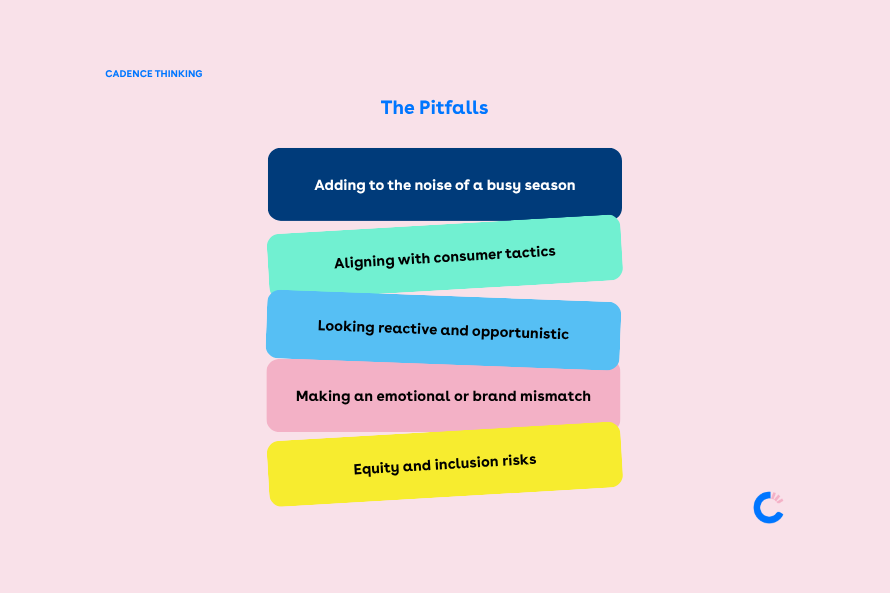
However, more often than not, these campaigns either don’t really work or they can harm your brand by looking opportunistic, reactive, and inauthentic.
This leaves us in a bit of a bind because we can all think of successful holiday-linked campaigns and we don’t want to throw the baby out with the bathwater. So how do we leverage holidays or National days without:
- Adding to the noise of a busy season?
- Aligning ourselves with consumer tactics?
- Looking reactive and opportunistic?
In this blog we’re going to help you think through the pros and cons of tying your campaign to a holiday and propose some solutions to get the best out of holiday marketing for your brand.
The Pros and Cons of Holiday-Linked Campaigns
Before jumping into a holiday ask, it is essential to weigh the benefits of holiday campaigns against the risks.
The Benefits
- Spend season: People are already spending, making them open to donation appeals.
- Heightened generosity: The holiday spirit encourages giving, kindness, and goodwill.
- Wider audience: Often people are more open to marketing around a holiday. This can expand the potential audience for your campaign to those unfamiliar with your brand.
- Positive brand building: Linking your brand to the holidays collective mood e.g., Mothers Day and appreciation.
- Loyalty: Campaigns tied to major holidays (e.g., Christmas, Anzac Day) attract faithful, annual donors.
- Time-bound and urgent: A short giving period (a month/weekend) creates urgency.
- Low barrier to entry messaging: Consumers quickly grasp the ask due to the holiday theme (e.g., food drives at Christmas-time).
- Brand partnerships: Holidays facilitate match-giving, corporate social responsibility goals, or media promotion. For example, corporate gift-matching for International Women’s Day.
- Peer to peer Ambassador campaigns: Time off or physical events (fetes, fun runs, Movember encourage volunteer involvement.
The Risks
- You’re competing with and adding to “The Noise”: Have you ever opened your inbox on October 31st, to find multiple emails with subject lines playing on ‘trick or treat’? Your message is competing with hundreds of other charities (not to mention brands!), many of whom have large advertising budgets. In addition, you end up contributing to the noise of many charities asking for money around holidays.
- Donor fatigue: If it’s a busy time of year, supporters can feel overwhelmed by constant requests, leading them to unsubscribe or stop opening emails. Once someone has unsubscribed from your emails it is quite hard to win them back.
- Higher costs: Advertising costs (CPC) typically spike during holiday seasons as you compete with both NFPs and commercial retailers.
- Misleading signals: For organisations like food banks, a heavy holiday focus may inadvertently signal that the need only exists during that season, causing a massive drop-off in support the rest of the year.
Our solutions for authentic holiday marketing
If you decide to move forward with a holiday-linked campaign, follow these principles to maintain your brand’s integrity:
1. Make it count
Don’t treat a holiday campaign as an afterthought to squeeze out extra donations. If you do it, make it one of your core brand campaigns. Put in the effort and creativity required for the messaging to stand up on its own, speaking deeply to the actual need you are fundraising for.
Example: The American Heart Association rebranded February (eg. Valentine’s Day) as American Heart Month. They pivot the visual language of hearts and romance toward physical heart health and CPR awareness.
2. Only use dates that align with your brand
Holidays have brands too. Some are fun and celebratory. Others are solemn and commemorative. It is important that the holiday you choose actually bolsters your brand rather than looking like an opportunistic grab. For example, if your organisation focuses on foreign aid, Halloween is a bit of a tenuous link; Harmony Day or a creative fundraising product like a forty hour famine might be more appropriate.
Example: The RSL’s Anzac Appeal works because it is spiritually aligned with Anzac Day. It centres on a solemn day of remembrance where buying a badge feels like an act of commemoration rather than a sales pitch.
3. Acknowledge your audience’s experience
Acknowledge the reality that holidays can be busy and expensive for your donors. Adjust your language and make the mechanism for giving as simple as possible. If you don’t have clear data to back up a large financial ask, consider using the holiday for awareness, goodwill, and donor retention instead.
Example: Save the Children’s Christmas Jumper Day turns a popular tradition into a low-effort, highly visual way to give. It’s easy for schools and workplaces to execute during a busy season.
4. The Alternative: create your own signature moment
If the traditional holiday calendar feels too crowded, consider creating a signature campaign linked to a specific date that you own. Successes like Movember, Dressember, and the Pink Test prove that you don’t need a national holiday to create a movement.
Alternatively, focus on a year round, always on awareness strategy. By providing content for them such as recipes from OzHarvest or heart health tips from the Heart Foundation, you build an audience that is receptive when you litter in your donation asks throughout the year.